Subspaces, span, and basis
Subspaces, span, and basis[edit]
The study of those subsets of vector spaces that are in themselves vector spaces under the induced operations is fundamental, similarly as for many mathematical structures. These subsets are called linear subspaces. More precisely, a linear subspace of a vector space V over a field F is a subset W of V such that u + v and au are in W, for every u, v in W, and every a in F. (These conditions suffice for implying that W is a vector space.)
For example, given a linear map T : V → W, the image T(V) of V, and the inverse image T−1(0) of 0 (called kernel or null space), are linear subspaces of W and V, respectively.
Another important way of forming a subspace is to consider linear combinations of a set S of vectors: the set of all sums

where v1, v2, ..., vk are in S, and a1, a2, ..., ak are in F form a linear subspace called the span of S. The span of S is also the intersection of all linear subspaces containing S. In other words, it is the smallest (for the inclusion relation) linear subspace containing S.
A set of vectors is linearly independent if none is in the span of the others. Equivalently, a set S of vectors is linearly independent if the only way to express the zero vector as a linear combination of elements of S is to take zero for every coefficient ai.
A set of vectors that spans a vector space is called a spanning set or generating set. If a spanning set S is linearly dependent (that is not linearly independent), then some element w of S is in the span of the other elements of S, and the span would remain the same if one remove w from S. One may continue to remove elements of S until getting a linearly independent spanning set. Such a linearly independent set that spans a vector space V is called a basis of V. The importance of bases lies in the fact that they are simultaneously minimal generating sets and maximal independent sets. More precisely, if S is a linearly independent set, and T is a spanning set such that S ⊆ T, then there is a basis B such that S ⊆ B ⊆ T.
Any two bases of a vector space V have the same cardinality, which is called the dimension of V; this is the dimension theorem for vector spaces. Moreover, two vector spaces over the same field F are isomorphic if and only if they have the same dimension.[8]
If any basis of V (and therefore every basis) has a finite number of elements, V is a finite-dimensional vector space. If U is a subspace of V, then dim U ≤ dim V. In the case where V is finite-dimensional, the equality of the dimensions implies U = V.
If U1 and U2 are subspaces of V, then

where U1 + U2 denotes the span of U1 ∪ U2.[9]
Matrices[edit]
Matrices allow explicit manipulation of finite-dimensional vector spaces and linear maps. Their theory is thus an essential part of linear algebra.
Let V be a finite-dimensional vector space over a field F, and (v1, v2, ..., vm) be a basis of V (thus m is the dimension of V). By definition of a basis, the map

is a bijection from Fm, the set of the sequences of m elements of F, onto V. This is an isomorphism of vector spaces, if Fm is equipped of its standard structure of vector space, where vector addition and scalar multiplication are done component by component.
This isomorphism allows representing a vector by its inverse image under this isomorphism, that is by the coordinate vector (a1, ..., am) or by the column matrix

If W is another finite dimensional vector space (possibly the same), with a basis (w1, ..., wn), a linear map f from W to V is well defined by its values on the basis elements, that is (f(w1), ..., f(wn)). Thus, f is well represented by the list of the corresponding column matrices. That is, if

for j = 1, ..., n, then f is represented by the matrix
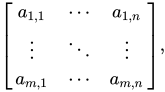
with m rows and n columns.
Matrix multiplication is defined in such a way that the product of two matrices is the matrix of the composition of the corresponding linear maps, and the product of a matrix and a column matrix is the column matrix representing the result of applying the represented linear map to the represented vector. It follows that the theory of finite-dimensional vector spaces and the theory of matrices are two different languages for expressing exactly the same concepts.
Two matrices that encode the same linear transformation in different bases are called similar. It can be proved that two matrices are similar if and only if one can transform one into the other by elementary row and column operations. For a matrix representing a linear map from W to V, the row operations correspond to change of bases in V and the column operations correspond to change of bases in W. Every matrix is similar to an identity matrix possibly bordered by zero rows and zero columns. In terms of vector spaces, this means that, for any linear map from W to V, there are bases such that a part of the basis of W is mapped bijectively on a part of the basis of V, and that the remaining basis elements of W, if any, are mapped to zero. Gaussian elimination is the basic algorithm for finding these elementary operations, and proving these results.
Comments
Post a Comment