Algebraic multiplicity
Algebraic multiplicity
Let λi be an eigenvalue of an n by n matrix A. The algebraic multiplicity μA(λi) of the eigenvalue is its multiplicity as a root of the characteristic polynomial, that is, the largest integer k such that (λ − λi)k divides evenly that polynomial.[9][25][26]
Suppose a matrix A has dimension n and d ≤ n distinct eigenvalues. Whereas Equation (4) factors the characteristic polynomial of A into the product of n linear terms with some terms potentially repeating, the characteristic polynomial can instead be written as the product of d terms each corresponding to a distinct eigenvalue and raised to the power of the algebraic multiplicity,

If d = n then the right-hand side is the product of n linear terms and this is the same as Equation (4). The size of each eigenvalue's algebraic multiplicity is related to the dimension n as
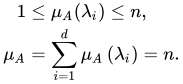
If μA(λi) = 1, then λi is said to be a simple eigenvalue.[26] If μA(λi) equals the geometric multiplicity of λi, γA(λi), defined in the next section, then λi is said to be a semisimple eigenvalue.
Eigenspaces, geometric multiplicity, and the eigenbasis for matrices[edit]
Given a particular eigenvalue λ of the n by n matrix A, define the set E to be all vectors v that satisfy Equation (2),

On one hand, this set is precisely the kernel or nullspace of the matrix (A − λI). On the other hand, by definition, any nonzero vector that satisfies this condition is an eigenvector of A associated with λ. So, the set E is the union of the zero vector with the set of all eigenvectors of A associated with λ, and E equals the nullspace of (A − λI). E is called the eigenspace or characteristic space of A associated with λ.[27][9] In general λ is a complex number and the eigenvectors are complex n by 1 matrices. A property of the nullspace is that it is a linear subspace, so E is a linear subspace of .

Because the eigenspace E is a linear subspace, it is closed under addition. That is, if two vectors u and v belong to the set E, written u, v ∈ E, then (u + v) ∈ E or equivalently A(u + v) = λ(u + v). This can be checked using the distributive property of matrix multiplication. Similarly, because E is a linear subspace, it is closed under scalar multiplication. That is, if v ∈ E and α is a complex number, (αv) ∈ E or equivalently A(αv) = λ(αv). This can be checked by noting that multiplication of complex matrices by complex numbers is commutative. As long as u + v and αv are not zero, they are also eigenvectors of A associated with λ.
The dimension of the eigenspace E associated with λ, or equivalently the maximum number of linearly independent eigenvectors associated with λ, is referred to as the eigenvalue's geometric multiplicity γA(λ). Because E is also the nullspace of (A − λI), the geometric multiplicity of λ is the dimension of the nullspace of (A − λI), also called the nullity of (A − λI), which relates to the dimension and rank of (A − λI) as

Because of the definition of eigenvalues and eigenvectors, an eigenvalue's geometric multiplicity must be at least one, that is, each eigenvalue has at least one associated eigenvector. Furthermore, an eigenvalue's geometric multiplicity cannot exceed its algebraic multiplicity. Additionally, recall that an eigenvalue's algebraic multiplicity cannot exceed n.

To prove the inequality , consider how the definition of geometric multiplicity implies the existence of orthonormal eigenvectors , such that . We can therefore find a (unitary) matrix whose first columns are these eigenvectors, and whose remaining columns can be any orthonormal set of vectors orthogonal to these eigenvectors of . Then has full rank and is therefore invertible, and with a matrix whose top left block is the diagonal matrix . This implies that . In other words, is similar to , which implies that . But from the definition of we know that contains a factor , which means that the algebraic multiplicity of must satisfy .












Suppose has distinct eigenvalues , where the geometric multiplicity of is . The total geometric multiplicity of ,


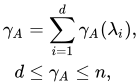
is the dimension of the sum of all the eigenspaces of 's eigenvalues, or equivalently the maximum number of linearly independent eigenvectors of . If , then

- The direct sum of the eigenspaces of all of 's eigenvalues is the entire vector space .
- A basis of can be formed from linearly independent eigenvectors of ; such a basis is called an eigenbasis
- Any vector in can be written as a linear combination of eigenvectors of .

Additional properties of eigenvalues[edit]
Let be an arbitrary matrix of complex numbers with eigenvalues . Each eigenvalue appears times in this list, where is the eigenvalue's algebraic multiplicity. The following are properties of this matrix and its eigenvalues:


- The trace of , defined as the sum of its diagonal elements, is also the sum of all eigenvalues,[28][29][30]
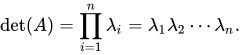
- The determinant of is the product of all its eigenvalues,[28][31][32]
- The eigenvalues of the th power of ; i.e., the eigenvalues of , for any positive integer , are .
- The matrix is invertible if and only if every eigenvalue is nonzero.
- If is invertible, then the eigenvalues of are and each eigenvalue's geometric multiplicity coincides. Moreover, since the characteristic polynomial of the inverse is the reciprocal polynomial of the original, the eigenvalues share the same algebraic multiplicity.
- If is equal to its conjugate transpose , or equivalently if is Hermitian, then every eigenvalue is real. The same is true of any symmetric real matrix.
- If is not only Hermitian but also positive-definite, positive-semidefinite, negative-definite, or negative-semidefinite, then every eigenvalue is positive, non-negative, negative, or non-positive, respectively.
- If is unitary, every eigenvalue has absolute value .
- if is a matrix and are its eigenvalues, then the eigenvalues of matrix (where is the identity matrix) are . Moreover, if , the eigenvalues of are . More generally, for a polynomial the eigenvalues of matrix are .










Left and right eigenvectors[edit]
Many disciplines traditionally represent vectors as matrices with a single column rather than as matrices with a single row. For that reason, the word "eigenvector" in the context of matrices almost always refers to a right eigenvector, namely a column vector that right multiplies the matrix in the defining equation, Equation (1),

The eigenvalue and eigenvector problem can also be defined for row vectors that left multiply matrix . In this formulation, the defining equation is

where is a scalar and is a matrix. Any row vector satisfying this equation is called a left eigenvector of and is its associated eigenvalue. Taking the transpose of this equation,



Comparing this equation to Equation (1), it follows immediately that a left eigenvector of is the same as the transpose of a right eigenvector of , with the same eigenvalue. Furthermore, since the characteristic polynomial of is the same as the characteristic polynomial of , the eigenvalues of the left eigenvectors of are the same as the eigenvalues of the right eigenvectors of .

Diagonalization and the eigendecomposition[edit]
Suppose the eigenvectors of A form a basis, or equivalently A has n linearly independent eigenvectors v1, v2, ..., vn with associated eigenvalues λ1, λ2, ..., λn. The eigenvalues need not be distinct. Define a square matrix Q whose columns are the n linearly independent eigenvectors of A,

Since each column of Q is an eigenvector of A, right multiplying A by Q scales each column of Q by its associated eigenvalue,

With this in mind, define a diagonal matrix Λ where each diagonal element Λii is the eigenvalue associated with the ith column of Q. Then

Because the columns of Q are linearly independent, Q is invertible. Right multiplying both sides of the equation by Q−1,
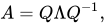
or by instead left multiplying both sides by Q−1,
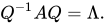
A can therefore be decomposed into a matrix composed of its eigenvectors, a diagonal matrix with its eigenvalues along the diagonal, and the inverse of the matrix of eigenvectors. This is called the eigendecomposition and it is a similarity transformation. Such a matrix A is said to be similar to the diagonal matrix Λ or diagonalizable. The matrix Q is the change of basis matrix of the similarity transformation. Essentially, the matrices A and Λ represent the same linear transformation expressed in two different bases. The eigenvectors are used as the basis when representing the linear transformation as Λ.
Conversely, suppose a matrix A is diagonalizable. Let P be a non-singular square matrix such that P−1AP is some diagonal matrix D. Left multiplying both by P, AP = PD. Each column of P must therefore be an eigenvector of A whose eigenvalue is the corresponding diagonal element of D. Since the columns of P must be linearly independent for P to be invertible, there exist n linearly independent eigenvectors of A. It then follows that the eigenvectors of A form a basis if and only if A is diagonalizable.
A matrix that is not diagonalizable is said to be defective. For defective matrices, the notion of eigenvectors generalizes to generalized eigenvectors and the diagonal matrix of eigenvalues generalizes to the Jordan normal form. Over an algebraically closed field, any matrix A has a Jordan normal form and therefore admits a basis of generalized eigenvectors and a decomposition into generalized eigenspaces.
Variational characterization[edit]
In the Hermitian case, eigenvalues can be given a variational characterization. The largest eigenvalue of is the maximum value of the quadratic form . A value of that realizes that maximum, is an eigenvector.


Matrix examples[edit]
Two-dimensional matrix example[edit]

![{\displaystyle \left[{\begin{smallmatrix}2&1\\1&2\end{smallmatrix}}\right]}](https://wikimedia.org/api/rest_v1/media/math/render/svg/838a30dc9d065ec434dff490bd84061ed569db3b)
Consider the matrix
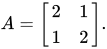
The figure on the right shows the effect of this transformation on point coordinates in the plane. The eigenvectors v of this transformation satisfy Equation (1), and the values of λ for which the determinant of the matrix (A − λI) equals zero are the eigenvalues.
Taking the determinant to find characteristic polynomial of A,
![{\displaystyle {\begin{aligned}|A-\lambda I|&=\left|{\begin{bmatrix}2&1\\1&2\end{bmatrix}}-\lambda {\begin{bmatrix}1&0\\0&1\end{bmatrix}}\right|={\begin{vmatrix}2-\lambda &1\\1&2-\lambda \end{vmatrix}}\\[6pt]&=3-4\lambda +\lambda ^{2}\\[6pt]&=(\lambda -3)(\lambda -1).\end{aligned}}}](https://wikimedia.org/api/rest_v1/media/math/render/svg/0084c80ab8c7637830cdf01f1c754f92a6598ac0)
Setting the characteristic polynomial equal to zero, it has roots at λ=1 and λ=3, which are the two eigenvalues of A.
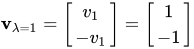
For λ=1, Equation (2) becomes,


Any nonzero vector with v1 = −v2 solves this equation. Therefore,
For λ=3, Equation (2) becomes
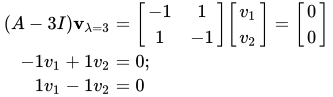
Any nonzero vector with v1 = v2 solves this equation. Therefore,
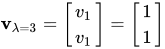
is an eigenvector of A corresponding to λ = 3, as is any scalar multiple of this vector.
Thus, the vectors vλ=1 and vλ=3 are eigenvectors of A associated with the eigenvalues λ=1 and λ=3, respectively.
Three-dimensional matrix example[edit]
Consider the matrix
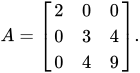
The characteristic polynomial of A is
![{\displaystyle {\begin{aligned}|A-\lambda I|&=\left|{\begin{bmatrix}2&0&0\\0&3&4\\0&4&9\end{bmatrix}}-\lambda {\begin{bmatrix}1&0&0\\0&1&0\\0&0&1\end{bmatrix}}\right|={\begin{vmatrix}2-\lambda &0&0\\0&3-\lambda &4\\0&4&9-\lambda \end{vmatrix}},\\[6pt]&=(2-\lambda ){\bigl [}(3-\lambda )(9-\lambda )-16{\bigr ]}=-\lambda ^{3}+14\lambda ^{2}-35\lambda +22.\end{aligned}}}](https://wikimedia.org/api/rest_v1/media/math/render/svg/30165fb86a7e23644d2e3373a1c2c68af4756523)
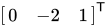
The roots of the characteristic polynomial are 2, 1, and 11, which are the only three eigenvalues of A. These eigenvalues correspond to the eigenvectors , , and , or any nonzero multiple thereof.


Three-dimensional matrix example with complex eigenvalues[edit]
Consider the cyclic permutation matrix
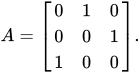
This matrix shifts the coordinates of the vector up by one position and moves the first coordinate to the bottom. Its characteristic polynomial is 1 − λ3, whose roots are
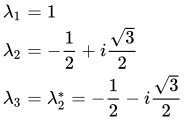
where is an imaginary unit with .


For the real eigenvalue λ1 = 1, any vector with three equal nonzero entries is an eigenvector. For example,
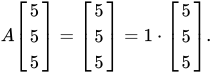
For the complex conjugate pair of imaginary eigenvalues,

Then
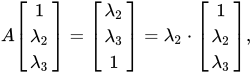
and
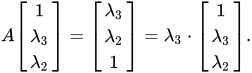
Therefore, the other two eigenvectors of A are complex and are and with eigenvalues λ2 and λ3, respectively. The two complex eigenvectors also appear in a complex conjugate pair,



Diagonal matrix example[edit]
Matrices with entries only along the main diagonal are called diagonal matrices. The eigenvalues of a diagonal matrix are the diagonal elements themselves. Consider the matrix
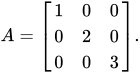
The characteristic polynomial of A is

which has the roots λ1 = 1, λ2 = 2, and λ3 = 3. These roots are the diagonal elements as well as the eigenvalues of A.
Each diagonal element corresponds to an eigenvector whose only nonzero component is in the same row as that diagonal element. In the example, the eigenvalues correspond to the eigenvectors,
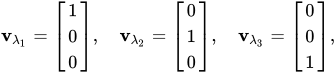
respectively, as well as scalar multiples of these vectors.
Triangular matrix example[edit]
A matrix whose elements above the main diagonal are all zero is called a lower triangular matrix, while a matrix whose elements below the main diagonal are all zero is called an upper triangular matrix. As with diagonal matrices, the eigenvalues of triangular matrices are the elements of the main diagonal.
Consider the lower triangular matrix,
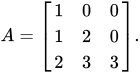
The characteristic polynomial of A is
which has the roots λ1 = 1, λ2 = 2, and λ3 = 3. These roots are the diagonal elements as well as the eigenvalues of A.
These eigenvalues correspond to the eigenvectors,
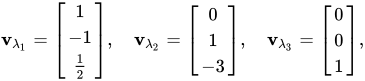
respectively, as well as scalar multiples of these vectors.
Matrix with repeated eigenvalues example[edit]
As in the previous example, the lower triangular matrix

has a characteristic polynomial that is the product of its diagonal elements,
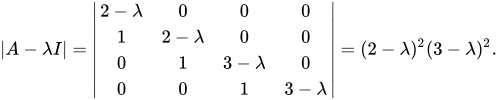
The roots of this polynomial, and hence the eigenvalues, are 2 and 3. The algebraic multiplicity of each eigenvalue is 2; in other words they are both double roots. The sum of the algebraic multiplicities of all distinct eigenvalues is μA = 4 = n, the order of the characteristic polynomial and the dimension of A.
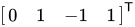
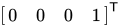
On the other hand, the geometric multiplicity of the eigenvalue 2 is only 1, because its eigenspace is spanned by just one vector and is therefore 1-dimensional. Similarly, the geometric multiplicity of the eigenvalue 3 is 1 because its eigenspace is spanned by just one vector . The total geometric multiplicity γA is 2, which is the smallest it could be for a matrix with two distinct eigenvalues. Geometric multiplicities are defined in a later section.
Eigenvector-eigenvalue identity[edit]
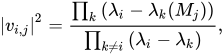
For a Hermitian matrix, the norm squared of the jth component of a normalized eigenvector can be calculated using only the matrix eigenvalues and the eigenvalues of the corresponding minor matrix,

Eigenvalues and eigenfunctions of differential operators[edit]
The definitions of eigenvalue and eigenvectors of a linear transformation T remains valid even if the underlying vector space is an infinite-dimensional Hilbert or Banach space. A widely used class of linear transformations acting on infinite-dimensional spaces are the differential operators on function spaces. Let D be a linear differential operator on the space C∞ of infinitely differentiable real functions of a real argument t. The eigenvalue equation for D is the differential equation
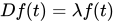
The functions that satisfy this equation are eigenvectors of D and are commonly called eigenfunctions.
Derivative operator example[edit]
Consider the derivative operator with eigenvalue equation

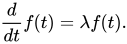
This differential equation can be solved by multiplying both sides by dt/f(t) and integrating. Its solution, the exponential function
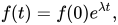
is the eigenfunction of the derivative operator. In this case the eigenfunction is itself a function of its associated eigenvalue. In particular, for λ = 0 the eigenfunction f(t) is a constant.
The main eigenfunction article gives other examples.
General definition[edit]
The concept of eigenvalues and eigenvectors extends naturally to arbitrary linear transformations on arbitrary vector spaces. Let V be any vector space over some field K of scalars, and let T be a linear transformation mapping V into V,

We say that a nonzero vector v ∈ V is an eigenvector of T if and only if there exists a scalar λ ∈ K such that
(5)

This equation is called the eigenvalue equation for T, and the scalar λ is the eigenvalue of T corresponding to the eigenvector v. T(v) is the result of applying the transformation T to the vector v, while λv is the product of the scalar λ with v.[36][37]
Eigenspaces, geometric multiplicity, and the eigenbasis[edit]
Given an eigenvalue λ, consider the set

which is the union of the zero vector with the set of all eigenvectors associated with λ. E is called the eigenspace or characteristic space of T associated with λ.
By definition of a linear transformation,
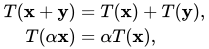
for x, y ∈ V and α ∈ K. Therefore, if u and v are eigenvectors of T associated with eigenvalue λ, namely u, v ∈ E, then
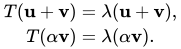
So, both u + v and αv are either zero or eigenvectors of T associated with λ, namely u + v, αv ∈ E, and E is closed under addition and scalar multiplication. The eigenspace E associated with λ is therefore a linear subspace of V.[38] If that subspace has dimension 1, it is sometimes called an eigenline.[39]
The geometric multiplicity γT(λ) of an eigenvalue λ is the dimension of the eigenspace associated with λ, i.e., the maximum number of linearly independent eigenvectors associated with that eigenvalue.[9][26] By the definition of eigenvalues and eigenvectors, γT(λ) ≥ 1 because every eigenvalue has at least one eigenvector.
The eigenspaces of T always form a direct sum. As a consequence, eigenvectors of different eigenvalues are always linearly independent. Therefore, the sum of the dimensions of the eigenspaces cannot exceed the dimension n of the vector space on which T operates, and there cannot be more than n distinct eigenvalues.[d]
Any subspace spanned by eigenvectors of T is an invariant subspace of T, and the restriction of T to such a subspace is diagonalizable. Moreover, if the entire vector space V can be spanned by the eigenvectors of T, or equivalently if the direct sum of the eigenspaces associated with all the eigenvalues of T is the entire vector space V, then a basis of V called an eigenbasis can be formed from linearly independent eigenvectors of T. When T admits an eigenbasis, T is diagonalizable.
Spectral theory[edit]
If λ is an eigenvalue of T, then the operator (T − λI) is not one-to-one, and therefore its inverse (T − λI)−1 does not exist. The converse is true for finite-dimensional vector spaces, but not for infinite-dimensional vector spaces. In general, the operator (T − λI) may not have an inverse even if λ is not an eigenvalue.
For this reason, in functional analysis eigenvalues can be generalized to the spectrum of a linear operator T as the set of all scalars λ for which the operator (T − λI) has no bounded inverse. The spectrum of an operator always contains all its eigenvalues but is not limited to them.
Associative algebras and representation theory[edit]
One can generalize the algebraic object that is acting on the vector space, replacing a single operator acting on a vector space with an algebra representation – an associative algebra acting on a module. The study of such actions is the field of representation theory.
The representation-theoretical concept of weight is an analog of eigenvalues, while weight vectors and weight spaces are the analogs of eigenvectors and eigenspaces, respectively.


Comments
Post a Comment