Linear systems
Linear systems[edit]
A finite set of linear equations in a finite set of variables, for example, x1, x2, ..., xn, or x, y, ..., z is called a system of linear equations or a linear system.[10][11][12][13][14]
Systems of linear equations form a fundamental part of linear algebra. Historically, linear algebra and matrix theory has been developed for solving such systems. In the modern presentation of linear algebra through vector spaces and matrices, many problems may be interpreted in terms of linear systems.
For example, let
(S)
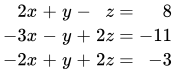
be a linear system.
To such a system, one may associate its matrix
![{\displaystyle M=\left[{\begin{array}{rrr}2&1&-1\\-3&-1&2\\-2&1&2\end{array}}\right].}](https://wikimedia.org/api/rest_v1/media/math/render/svg/fc5140ca13be8f555186b8d57b6223a4ef2e1b0b)
and its right member vector
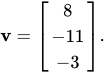
Let T be the linear transformation associated to the matrix M. A solution of the system (S) is a vector

such that

that is an element of the preimage of v by T.
Let (S′) be the associated homogeneous system, where the right-hand sides of the equations are put to zero:
(S′)
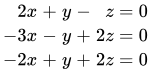
The solutions of (S′) are exactly the elements of the kernel of T or, equivalently, M.
The Gaussian-elimination consists of performing elementary row operations on the augmented matrix
![{\displaystyle \left[\!{\begin{array}{c|c}M&\mathbf {v} \end{array}}\!\right]=\left[{\begin{array}{rrr|r}2&1&-1&8\\-3&-1&2&-11\\-2&1&2&-3\end{array}}\right]}](https://wikimedia.org/api/rest_v1/media/math/render/svg/6a94bf6a98576cd520287535af3a6587376f9be8)
for putting it in reduced row echelon form. These row operations do not change the set of solutions of the system of equations. In the example, the reduced echelon form is
![{\displaystyle \left[\!{\begin{array}{c|c}M&\mathbf {v} \end{array}}\!\right]=\left[{\begin{array}{rrr|r}1&0&0&2\\0&1&0&3\\0&0&1&-1\end{array}}\right],}](https://wikimedia.org/api/rest_v1/media/math/render/svg/a6a99163495ae1cf328208d89cadcdf23397fba0)
showing that the system (S) has the unique solution

It follows from this matrix interpretation of linear systems that the same methods can be applied for solving linear systems and for many operations on matrices and linear transformations, which include the computation of the ranks, kernels, matrix inverses.
Endomorphisms and square matrices[edit]
A linear endomorphism is a linear map that maps a vector space V to itself. If V has a basis of n elements, such an endomorphism is represented by a square matrix of size n.
With respect to general linear maps, linear endomorphisms and square matrices have some specific properties that make their study an important part of linear algebra, which is used in many parts of mathematics, including geometric transformations, coordinate changes, quadratic forms, and many other part of mathematics.
Determinant[edit]
The determinant of a square matrix A is defined to be[15]
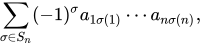
where Sn is the group of all permutations of n elements, σ is a permutation, and (−1)σ the parity of the permutation. A matrix is invertible if and only if the determinant is invertible (i.e., nonzero if the scalars belong to a field).
Cramer's rule is a closed-form expression, in terms of determinants, of the solution of a system of n linear equations in n unknowns. Cramer's rule is useful for reasoning about the solution, but, except for n = 2 or 3, it is rarely used for computing a solution, since Gaussian elimination is a faster algorithm.
The determinant of an endomorphism is the determinant of the matrix representing the endomorphism in terms of some ordered basis. This definition makes sense, since this determinant is independent of the choice of the basis.
Eigenvalues and eigenvectors[edit]
If f is a linear endomorphism of a vector space V over a field F, an eigenvector of f is a nonzero vector v of V such that f(v) = av for some scalar a in F. This scalar a is an eigenvalue of f.
If the dimension of V is finite, and a basis has been chosen, f and v may be represented, respectively, by a square matrix M and a column matrix z; the equation defining eigenvectors and eigenvalues becomes

Using the identity matrix I, whose entries are all zero, except those of the main diagonal, which are equal to one, this may be rewritten

As z is supposed to be nonzero, this means that M – aI is a singular matrix, and thus that its determinant det (M − aI) equals zero. The eigenvalues are thus the roots of the polynomial
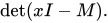
If V is of dimension n, this is a monic polynomial of degree n, called the characteristic polynomial of the matrix (or of the endomorphism), and there are, at most, n eigenvalues.
If a basis exists that consists only of eigenvectors, the matrix of f on this basis has a very simple structure: it is a diagonal matrix such that the entries on the main diagonal are eigenvalues, and the other entries are zero. In this case, the endomorphism and the matrix are said to be diagonalizable. More generally, an endomorphism and a matrix are also said diagonalizable, if they become diagonalizable after extending the field of scalars. In this extended sense, if the characteristic polynomial is square-free, then the matrix is diagonalizable.
A symmetric matrix is always diagonalizable. There are non-diagonalizable matrices, the simplest being

(it cannot be diagonalizable since its square is the zero matrix, and the square of a nonzero diagonal matrix is never zero).
When an endomorphism is not diagonalizable, there are bases on which it has a simple form, although not as simple as the diagonal form. The Frobenius normal form does not need of extending the field of scalars and makes the characteristic polynomial immediately readable on the matrix. The Jordan normal form requires to extend the field of scalar for containing all eigenvalues, and differs from the diagonal form only by some entries that are just above the main diagonal and are equal to 1.
Duality[edit]
A linear form is a linear map from a vector space V over a field F to the field of scalars F, viewed as a vector space over itself. Equipped by pointwise addition and multiplication by a scalar, the linear forms form a vector space, called the dual space of V, and usually denoted V*[16] or V′.[17][18]
If v1, ..., vn is a basis of V (this implies that V is finite-dimensional), then one can define, for i = 1, ..., n, a linear map vi* such that vi*(vi) = 1 and vi*(vj) = 0 if j ≠ i. These linear maps form a basis of V*, called the dual basis of v1, ..., vn. (If V is not finite-dimensional, the vi* may be defined similarly; they are linearly independent, but do not form a basis.)
For v in V, the map

is a linear form on V*. This defines the canonical linear map from V into (V*)*, the dual of V*, called the bidual of V. This canonical map is an isomorphism if V is finite-dimensional, and this allows identifying V with its bidual. (In the infinite dimensional case, the canonical map is injective, but not surjective.)
There is thus a complete symmetry between a finite-dimensional vector space and its dual. This motivates the frequent use, in this context, of the bra–ket notation

for denoting f(x).
Dual map[edit]
Let

be a linear map. For every linear form h on W, the composite function h ∘ f is a linear form on V. This defines a linear map

between the dual spaces, which is called the dual or the transpose of f.
If V and W are finite dimensional, and M is the matrix of f in terms of some ordered bases, then the matrix of f* over the dual bases is the transpose MT of M, obtained by exchanging rows and columns.
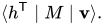
If elements of vector spaces and their duals are represented by column vectors, this duality may be expressed in bra–ket notation by

For highlighting this symmetry, the two members of this equality are sometimes written


Comments
Post a Comment