MATRICES
Matrices[edit]

Matrices are a useful notion to encode linear maps.[22] They are written as a rectangular array of scalars as in the image at the right. Any m-by-n matrix gives rise to a linear map from Fn to Fm, by the following




Moreover, after choosing bases of V and W, any linear map f : V → W is uniquely represented by a matrix via this assignment.[23]

The determinant det (A) of a square matrix A is a scalar that tells whether the associated map is an isomorphism or not: to be so it is sufficient and necessary that the determinant is nonzero.[24] The linear transformation of Rn corresponding to a real n-by-n matrix is orientation preserving if and only if its determinant is positive.
Eigenvalues and eigenvectors[edit]
Endomorphisms, linear maps f : V → V, are particularly important since in this case vectors v can be compared with their image under f, f(v). Any nonzero vector v satisfying λv = f(v), where λ is a scalar, is called an eigenvector of f with eigenvalue λ.[nb 4][25] Equivalently, v is an element of the kernel of the difference f − λ · Id (where Id is the identity map V → V). If V is finite-dimensional, this can be rephrased using determinants: f having eigenvalue λ is equivalent to

Basic constructions[edit]
In addition to the above concrete examples, there are a number of standard linear algebraic constructions that yield vector spaces related to given ones. In addition to the definitions given below, they are also characterized by universal properties, which determine an object by specifying the linear maps from to any other vector space.

Subspaces and quotient spaces[edit]

A nonempty subset of a vector space that is closed under addition and scalar multiplication (and therefore contains the -vector of ) is called a linear subspace of or simply a subspace of when the ambient space is unambiguously a vector space.[28][nb 6] Subspaces of are vector spaces (over the same field) in their own right. The intersection of all subspaces containing a given set of vectors is called its span, and it is the smallest subspace of containing the set Expressed in terms of elements, the span is the subspace consisting of all the linear combinations of elements of [29]


A linear subspace of dimension 1 is a vector line. A linear subspace of dimension 2 is a vector plane. A linear subspace that contains all elements but one of a basis of the ambient space is a vector hyperplane. In a vector space of finite dimension a vector hyperplane is thus a subspace of dimension


The counterpart to subspaces are quotient vector spaces.[30] Given any subspace the quotient space (" modulo ") is defined as follows: as a set, it consists of where is an arbitrary vector in The sum of two such elements and is and scalar multiplication is given by The key point in this definition is that if and only if the difference of and lies in [nb 7] This way, the quotient space "forgets" information that is contained in the subspace










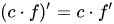
The kernel of a linear map consists of vectors that are mapped to in [31] The kernel and the image are subspaces of and respectively.[32] The existence of kernels and images is part of the statement that the category of vector spaces (over a fixed field ) is an abelian category, that is, a corpus of mathematical objects and structure-preserving maps between them (a category) that behaves much like the category of abelian groups.[33] Because of this, many statements such as the first isomorphism theorem (also called rank–nullity theorem in matrix-related terms)






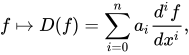
An important example is the kernel of a linear map for some fixed matrix as above.[clarification needed] The kernel of this map is the subspace of vectors such that which is precisely the set of solutions to the system of homogeneous linear equations belonging to This concept also extends to linear differential equations










Direct product and direct sum[edit]
The direct product of vector spaces and the direct sum of vector spaces are two ways of combining an indexed family of vector spaces into a new vector space.
The direct product of a family of vector spaces consists of the set of all tuples which specify for each index in some index set an element of [34] Addition and scalar multiplication is performed componentwise. A variant of this construction is the direct sum (also called coproduct and denoted ), where only tuples with finitely many nonzero vectors are allowed. If the index set is finite, the two constructions agree, but in general they are different.


Tensor product[edit]
The tensor product or simply of two vector spaces and is one of the central notions of multilinear algebra which deals with extending notions such as linear maps to several variables. A map from the Cartesian product is called bilinear if is linear in both variables and That is to say, for fixed the map is linear in the sense above and likewise for fixed





The tensor product is a particular vector space that is a universal recipient of bilinear maps as follows. It is defined as the vector space consisting of finite (formal) sums of symbols called tensors









Vector spaces with additional structure[edit]
From the point of view of linear algebra, vector spaces are completely understood insofar as any vector space over a given field is characterized, up to isomorphism, by its dimension. However, vector spaces per se do not offer a framework to deal with the question—crucial to analysis—whether a sequence of functions converges to another function. Likewise, linear algebra is not adapted to deal with infinite series, since the addition operation allows only finitely many terms to be added. Therefore, the needs of functional analysis require considering additional structures.
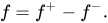
A vector space may be given a partial order under which some vectors can be compared.[37] For example, -dimensional real space can be ordered by comparing its vectors componentwise. Ordered vector spaces, for example Riesz spaces, are fundamental to Lebesgue integration, which relies on the ability to express a function as a difference of two positive functions




Comments
Post a Comment